Nature, People and Adaptation: Key Outcomes from COP30
26 Dec, 2025
By: S Tanbir Azmi, Communications and Knowledge Management Specialist, IGBP
COP 30, the 30th Conference of the Parties to the United Nations Framework Convention on Climate Change(UNFCC) in Belém concluded on 22 November 2025, with outcomes focused on adaptation, nature, finance and people centred approaches. Across the sessions, implementation moved closer to the centre of the agenda, with growing attention on how climate action translates into changes in employment, training systems and local economies, especially in sectors driving the low carbon transition.
Parties adopted the Global Mutirão decision as the central political outcome of COP30. The decision focused on accelerating implementation of existing Paris Agreement commitments rather than setting new binding targets.
COP30 called for climate adaptation finance to be at least tripled by 2035. The decision did not define a baseline year or specify binding contributions by developed countries.
Around 59 adaptation indicators for the Global Goal on Adaptation were adopted, covering water, agriculture, health and ecosystems, and intended to track progress over time.
A dialogue on trade and climate was formally introduced within the UNFCCC process for the first time. Parties agreed to hold discussions during intersessional meetings over the next three years.
A Just Transition Mechanism was launched to support fairness for workers and communities in the shift to low-carbon economies.
A Gender Action Plan was adopted to promote gender-responsive climate policy, planning and finance.
Brazil launched the Tropical Forests Forever Facility as a new mechanism to provide long-term, results-based finance to countries protecting tropical forests. Initial pledges of around USD 5.5–6.7 billion were announced by countries including Brazil, Germany, France and Norway.
The Baku to Belém Roadmap was presented as a framework to scale climate finance from all sources towards around USD 1.3 trillion per year for developing countries by 2035.
The COP30 Presidency launched two voluntary initiatives—the Global Implementation Accelerator and the Belém Mission to 1.5—to support faster implementation of national climate plans and national adaptation plans.
What was agreed:
Parties adopted the Belém Package of 29 decisions by consensus, including decisions on adaptation finance, just transition, trade, gender, technology cooperation, and indicators for adaptation.
The Mutirão decision included commitments to strengthen cooperation and implementation of existing Paris goals rather than setting new binding targets.
Guidance was agreed for the Fund for Responding to Loss and Damage, and the Fund opened its first call for funding requests for the startup phase.
What still needs consensus:
No formal roadmap to phase out fossil fuels was included in the COP30 negotiated text, despite proposals from several countries.
No global deforestation roadmap was agreed within the UNFCCC text. Brazil and others signalled intentions to develop such a roadmap outside the formal process, but it was not part of the negotiated package.
There was no consensus on how to address the emissions gap between national climate plans (NDCs) and the 1.5 °C target within the negotiated outcome.
The scale and terms of climate finance remain contested. Developed and developing countries diverge on how much should be provided and in what form (e.g., grants or concessional finance) to meet adaptation, mitigation, and loss & damage needs.
India’s Position at COP30:
In its closing plenary statement, India placed equity and climate justice at the centre of its position. India called on developed countries to meet their climate finance obligations under Article 9.1 of the Paris Agreement and to support countries and communities most vulnerable to climate impacts.
The official Press Information Bureau noted that India emphasised “long-standing obligations of developed countries to provide climate finance” and warned that “the burden of climate change mitigation must not be shifted onto the shoulders of those who have the least responsibility in causing the problem”.
India welcomed the Just Transition Mechanism as a significant milestone for equity and climate justice and supported dialogue on unilateral trade-restrictive climate measures, stating these concerns cannot be “brushed under the carpet”.
Union Minister for Environment, Forest and Climate Change Bhupender Yadav described COP30 as a “COP of implementation” and “a COP of delivery on promises”. He said, “Developed countries must reach net zero far earlier than current target dates and deliver new, additional and concessional climate finance at a scale of trillions, not billions”, and added, “Let the next decade be one of implementation, resilience and shared responsibility”.



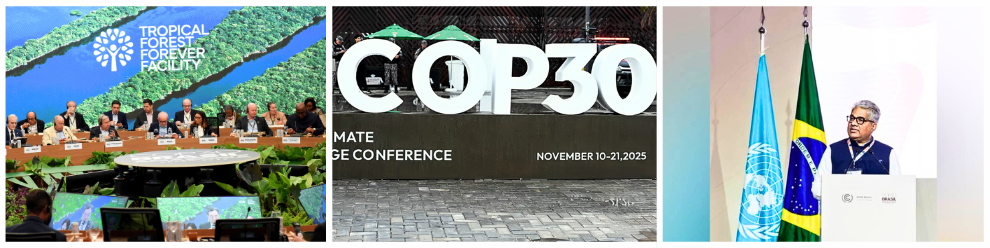 Left and Centre: ©UNFCC COP 30; Right: © PIB, Delhi